
Inspiration, Exchange and New Perspectives
This year, we once again attended the IALD Enlighten Europe conference, which took place in Paris. As in the previous year, the event offered a valuable opportunity to gather new inspiration, discuss current topics in the lighting industry, and meet interesting people with their projects, questions and perspectives.
It is impossible to report on everything that was addressed during the conference. The programme was too diverse and the range of topics too broad. What follows, therefore, is a personal selection of the presentations and thoughts that moved me most.
Light, Sustainability and the Protection of the Night
One of the central themes of the conference was the question of how lighting design can become more responsible, resource-conscious and sustainable. As part of the Pre-Conference, Leela Shanker and Vicki Rybl demonstrated in their “Lighting Specifications Design Lab” how sustainability assessments can be meaningfully integrated into the planning process and the selection of products. Terms and tools such as Life Cycle Assessment, Environmental Product Declarations, Embodied Carbon, TM65 and Carbon Budgets were not treated as abstract concepts, but presented as practical guides for making better decisions in the design process.
One of the surprises for me was Paul Beale’s presentation, in which he impressively showed, through his project “18 Circular”, how circular approaches in the lighting industry can be conceived and implemented in practice. His remarks on “Cat. A Lighting” made it clear how important it is to have people who question existing processes and move the industry towards reuse, resource conservation and a circular economy that is thought through to its logical conclusion.
Yana Yakushina opened up another important perspective on sustainability in her presentation “Protecting the Night”. She gave an overview of current regulatory developments in relation to light pollution and the use of artificial light at night. The focus was on political discussions, different legal approaches and initiatives such as ROLAN and DarkSky. These provide the lighting industry with important guidance for responsible outdoor lighting that not only shapes urban space, but also protects the night, human health and nature.
Lighting Design and Artificial Intelligence
As expected, artificial intelligence was also at the centre of many discussions. What was particularly interesting was that the debate was conducted in a very nuanced way. In the presentations as well as in conversations, the focus was on very concrete questions: What is AI useful and meaningful for in lighting design? Which tasks can be usefully automated? And which areas should designers consciously continue to claim for themselves?
Closely connected to this is the question of how the services offered by lighting designers will need to change when individual planning tasks can be solved reliably and efficiently by AI. Which skills and services will be added when others disappear? This shift in particular makes it clear that AI is not merely a technical tool, but also touches on the self-understanding of creative work.
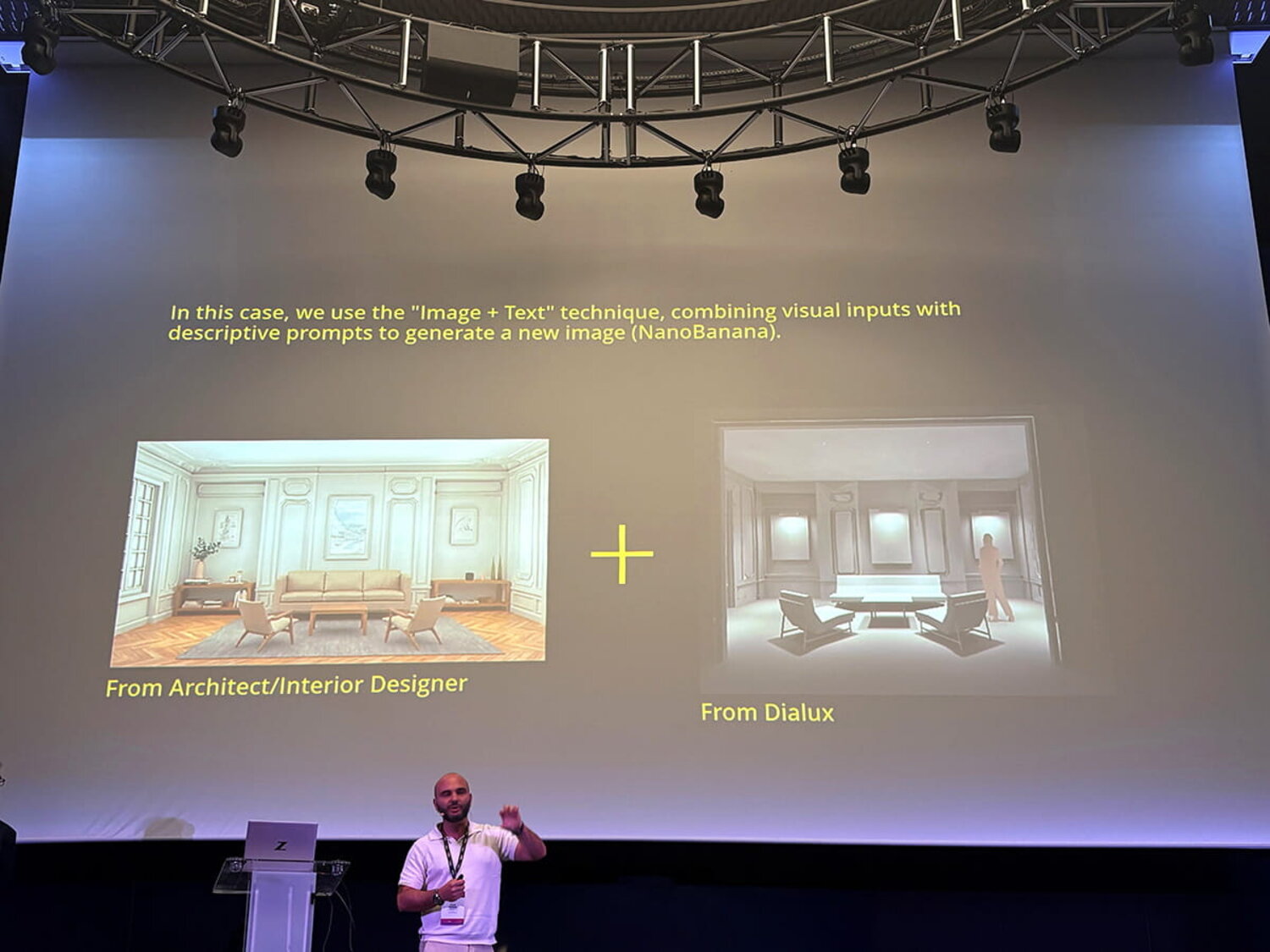
Reza Jalalzadeh Asrjadidi and Carlo Pedata from the lighting team at Foster + Partners showed in their presentation, in a very differentiated way, which challenges the use of generative AI raises in a professional context. These include the protection of intellectual property, responsibility for design decisions, the confidentiality of client data and the role of creative authorship. They also illustrated clearly how their design process is changing: generated reference images, combined with a realistic lighting simulation from DIALux, can result in a convincing visualisation of an overall concept that gives clients a very clear picture of the design idea.
Daniel Green and Kuldeep Vali provided an insightful overview of how lighting designers at different levels of experience can use AI to make their planning workflow more efficient with existing tools, with little or no coding required. Especially for routine tasks, such as creating concept sketches and luminaire schedules or evaluating and summarizing large amounts of data, existing AI solutions offer significant potential for automation.
Dean Skira presented another exciting approach. He showed how outdoor lighting can be conceived with the help of AI down to batch size one: in other words, with the idea of developing a luminaire with an individual light distribution for a single position. For him, too, the protection of the night sky was at the centre, combined with the aim of illuminating outdoor spaces efficiently, and with a high level of comfort.
Lighting Design as a Craft in the Real World
A strong counterpoint to the discussions about AI, automation and simulation was provided by a very hands-on approach to lighting design. In his project presentation “From Darkness to Light”, Philipp Schmitz of Licht Kunst Licht gave a detailed insight into the lighting of Cologne Cathedral.
In direct contrast to the use of AI or simulations, it became clear that this project was implemented entirely by hand due to its complexity and the particular nature of the building structure. Starting from an overarching concept that highlights the characteristics of Gothic architecture, every single luminaire position was individually determined, tested with mock-ups, measured and installed. This project, too, made extensive reference to the question of how light can be used as a resource in urban space in a sustainable, deliberate way while maintaining a high level of conceptual and aesthetic quality.
Light as Part of Human Experience
Beyond the application-oriented and technical topics, another thematic arc emerged: many contributions referred back to the core of designing with light and working with light as a medium. They addressed human perception and experience, and a dimension that goes far beyond the purely visual.
In his keynote “LIGHT – Stillness and Movement”, Ian Ritchie directed attention to light as a fundamental material of architecture. He particularly emphasized the dynamics of light as an essential element and showed how natural and artificial light shape form, space, material and perception. For Ritchie, light and shadow, wave and particle are interconnected forces that influence our sense of movement, balance and atmosphere in space.
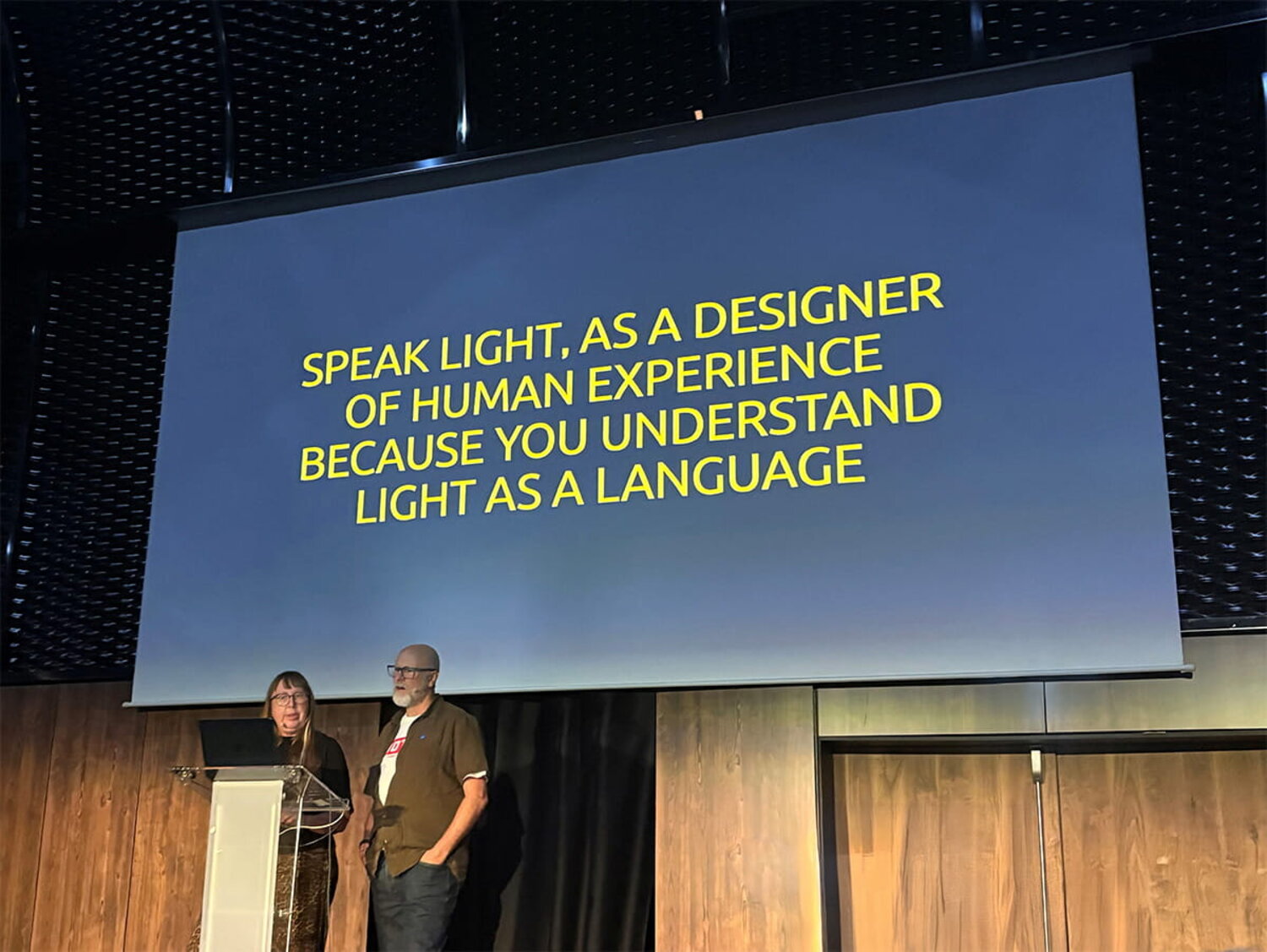
A particular highlight for me was the presentation by Sharon Stammers and Martin Lupton of Light Collective. They explored the meaning of light as a language of human experience and, with wide-ranging references to philosophy, art, physics and spirituality, showed how light not only illuminates spaces, but also creates meaning and allows spaces to “speak”. Starting from the role of darkness, they raised the question of how artificial light changes our understanding of atmosphere, culture and experience. Their journey ended with a call to understand light not merely as a technical quantity, but as an essential medium for meaningful spaces and human experience.
Paris as a Stage for Lighting Culture
As the “City of Light”, Paris is in many ways a cultural center of light. This made the city a very fitting stage for such a multifaceted event. And for the lively, open IALD community, which enables exchange between design, planning, research and industry in a very special way.
Enlighten Europe once again demonstrated how broad and relevant the topics of today’s lighting industry are: from sustainability and circular economy to artificial intelligence and digital tools, and on to perception, culture and human experience. It is precisely this diversity that makes the conference so valuable. It shows that lighting design requires technical knowledge, a design attitude, social responsibility and cultural sensitivity in equal measures.
